
Guide
How to Play Mahjong Solitaire: A Complete Beginner's Guide
Published July 13, 2026
If you've never played Mahjong Solitaire before, the board looks intimidating — a jumbled pyramid of a hundred-plus tiles with no visible starting point and no obvious first move. The good news is that the entire game comes down to one question, asked over and over: can I actually reach this tile? Once that clicks, everything else is practice.
The Rules, Start to Finish
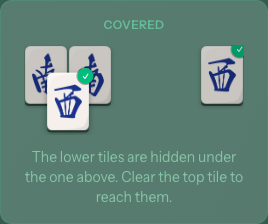
Every board is a pyramid built from several stacked layers. Picture it from the side: a wide base, with the next layer's tiles resting half-overlapped on top of it, and so on up to a single tile at the peak. You never actually see it from the side — the game flattens the whole thing into one view and uses shadow and brightness to hint at depth instead, so tiles higher up read brighter and the ones buried underneath look dim and slightly duller.
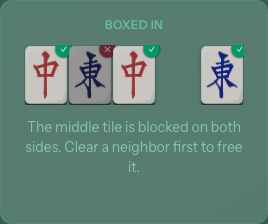
You can only pick up a tile that's free: nothing sitting directly on top of it, and at least one full side — left or right — with no neighbor in the way. This is the part that trips almost everyone up at first, because a tile can be completely uncovered from above and still be unplayable, boxed in by neighbors on both sides. The game will show you the tile clearly; it just won't let you select it. Seeing a tile isn't the same as being able to touch it.
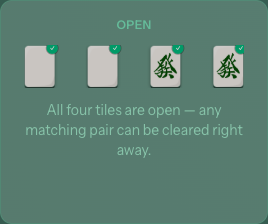
Once you've got two free tiles showing the same face, click them both and they're gone — usually opening up whatever was resting on top of or beside them for your next move. Clear every tile on the board and you've solved it. That's the entire loop; there's no deeper trick to learn, just faster ways of reading it, which is what the tips further down are for.
You're not doing this alone, either. Three tools sit off to the side for whenever you get stuck: Shuffle re-deals the faces on whatever tiles are still standing without moving their positions, Hint briefly flashes one matching pair so you can catch your breath, and Undo reverses your last match if you realize too late it was the wrong one. And if you ever run out of legal moves entirely, the board fixes itself automatically at no cost to you — worth reading about in detail in our guide to getting stuck if it happens to you on your first few boards, because it will.
Where the Tiles Actually Come From
The 34 tile faces — Bamboos, Circles, Characters, the four Winds, the three Dragons, and the Flower/Season tiles — weren't invented for this game. They're the tool set of "real" Mahjong, a 19th-century Chinese four-player game played with racks, a wall of tiles, and calls like Pong and Chow. That game has no pyramid, no pairs-matching, and no single-player mode whatsoever; if you sat down at a real Mahjong table expecting this, you'd be lost in about ten seconds.
Mahjong Solitaire borrowed the tile art and nothing else. It caught on in the West in the 1980s — often under the name "Shanghai," after an early commercial release — when computer game designers realized the tile set's visual variety was perfect for a single-player matching puzzle. It spread through Windows and web solitaire collections through the '90s and 2000s, and the pyramid-clearing format from that era is basically what you're playing here, unchanged.
A Few Terms You'll Run Into
You don't need to memorize any of this before you start — it's here to check back against once something on the board doesn't make sense.
- Free / open tile.
- Nothing on top of it, one full side clear — the only kind of tile you can actually click.
- Blocked tile.
- Fully uncovered but boxed in on both sides — visible, not yet playable.
- Layer / stack depth.
- How many tiles sit above this one. Deeper tiles look dimmer and stay hidden until everything above them clears.
- Honors.
- The Wind and Dragon tiles — no numbers, just a single symbol, four copies each, same as the numbered suits.
- Flowers & Seasons.
- Eight tiles that are unique in real Mahjong but treated as ordinary matchable pairs here.
- Combo.
- A score multiplier that builds while you match quickly and resets if you pause too long.
Six Things I'd Tell a First-Timer
- Clear the peak before you chase easy pairs at the base. Tiles higher up unlock more of the board per match than tiles at ground level do. It's tempting to grab the obvious pair sitting right in front of you, but the top of the pyramid is what's actually gatekeeping everything else — leave it too long and you'll end up with a wide, scattered mess of blocked tiles down low.
- Watch which faces are running out. Every tile exists in exactly four copies. Once three of a kind are gone, the fourth is suddenly precious — if it gets buried or boxed in, its last partner is stuck too. Match down to one remaining pair before either tile drifts somewhere hard to reach.
- Save Undo for real mistakes, not every twitchy click. You only get a handful of uses per board. It's for the moment you clear a pair and immediately realize a better option was sitting one tile over — not a general-purpose safety net.
- A tile being uncovered doesn't mean it's free. This is the single most common way people convince themselves the board is stuck when it isn't. Check both sides, every time, before writing a tile off.
- Bank a few matches before cashing in a combo streak. Boards often thin out into several simultaneously available pairs near the end. Rather than clearing the instant you spot each one, line a few up mentally, then fire them off back-to-back to stack the multiplier before the board runs dry.
- Level mode and Express reward different instincts. Level mode has no clock, so there's no cost to sitting and staring at the whole board before committing. Express is timed, so it punishes overthinking — the two modes are basically testing opposite skills, and it's worth being decent at both.
This Isn't Real Mahjong, and It Isn't Klondike Either
Worth saying plainly, since the name causes genuine confusion: real Mahjong is a four-player game about building specific hands from tiles you draw and discard. It shares a tile set with this game and nothing else — no pyramid, no single-player mode, no pairs-matching at all. If someone teaches you real Mahjong expecting you already "know how to play" because you've cleared a few Mahjong Solitaire boards, you're starting from zero.
It's also a different animal from card-based solitaire like Klondike, FreeCell, or Spider, which are about sequencing and suit order within a deck — planning several moves of card movement ahead. Mahjong Solitaire has no sequencing whatsoever. The entire skill is spatial: reading what's actually reachable in a stacked layout and matching identical pairs before you run out of legal moves.
One more thing worth knowing if you've bounced off other versions of this game before: not every Mahjong Solitaire dealt board is winnable. A lot of implementations just deal tiles at random and accept that some fraction of boards are dead on arrival through no fault of yours. Every board here is built the opposite way — backwards, from empty — which is what makes it provably solvable every time. The stuck-board guide goes into exactly how that works.
More Guides
-
Mahjong Solitaire Stuck? What "No More Moves" Means
Why boards get stuck, why every board here is guaranteed solvable, and when to reach for Shuffle, Undo, or Hint.
-
Mahjong Solitaire Board Layouts, Ranked
All 10 Level mode shapes plus the 3 Express layouts, ranked from easiest to hardest.